
|

|
|

|
Santorini: Akrotiri |

|
|
|
|
| Astronomy Home INAF CPO INAF Other Links Home Hans Cosmology (pdf) ATESP CO Seyferts Galaxy Profiles WENSS Personal CV Articles Santorini I. Introduction II. Site III. History IV. Atlantis V. Impressions |
Akrotiri on Santorini: I. Introduction Santorini,
or Thera as it is also called, is considered by many as the most
beautiful of all the Greek Islands. If not the most beautiful it is
certainly the most spectacular. It is located some 100 kms north of
Crete and has a rather peculiar shape, due to past
One of the most
fascinating archeological sites is Akrotiri on the Greek Island
of Santorini. Of course this is a personal opinion, but I
have seen quite a lot of excavations and do not remember any
other
place that gave
me such a strong feeling of emotion. First of all, when you enter
the site you
find yourself not in a place with lots of rubble to be
interpreted with a book
in your hand, but in a real town with houses, a small square
(actually a
triangle) and narrow streets. Second, this town is still as it
was about 3500
years ago, when it had to be abandoned by its inhabitants, when
the island was
about to explode. Almost immediately after the excavations
started (in 1967) some sensationally beautiful wall paintings were
found, some of which have become iconic: the fisherman you can now find
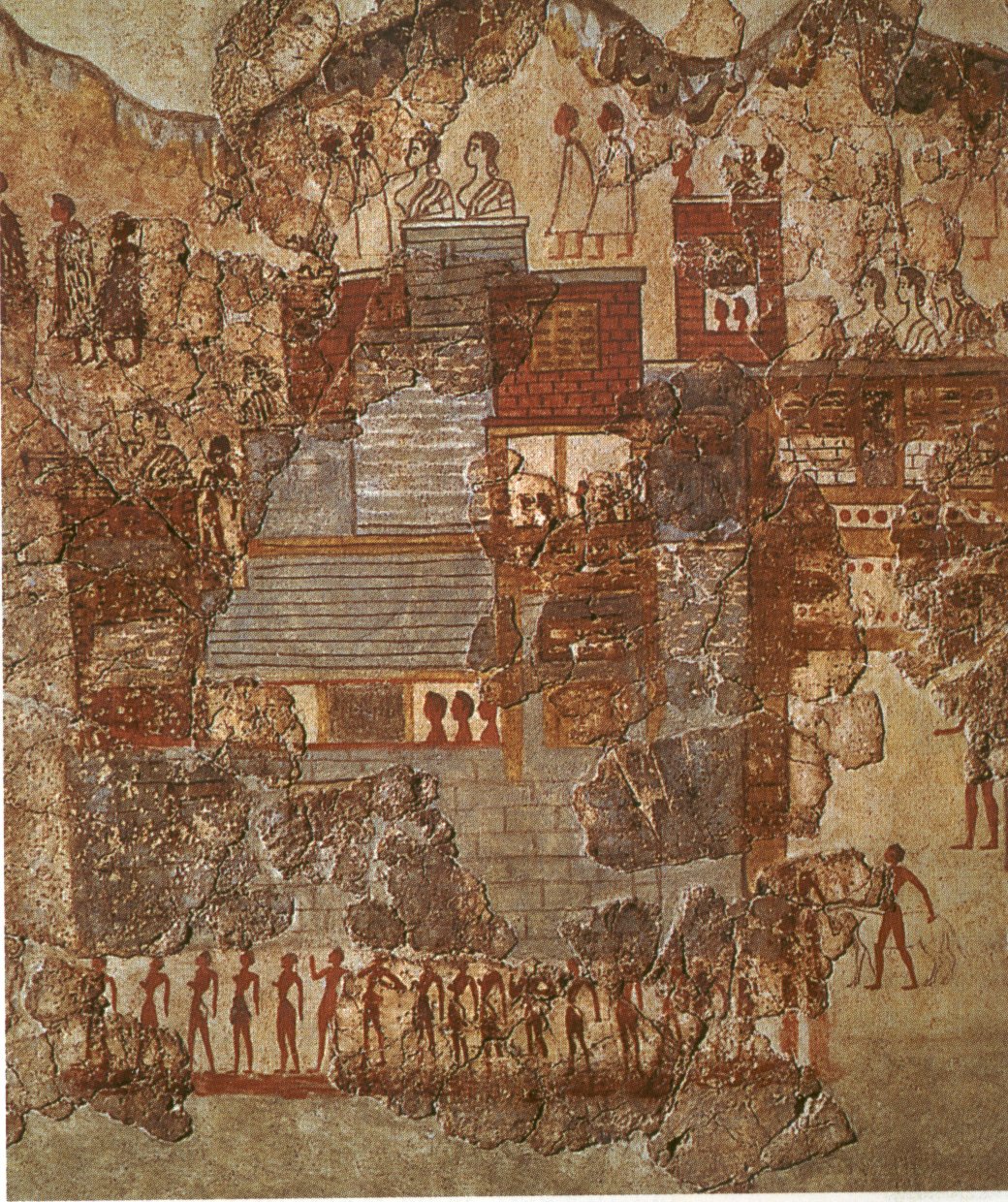
everywhere as a standard illustration of the Minoic epoch. The one shown
on the right even gives you a glimpse of how the old Minoic town must
have
looked like.
Since modern excavations at the Akrotiri site started, about
fifty years ago, there has been much
speculation about the volcanic explosion that destroyed Akrotiri,
and perhaps
the entire Minoic civilisation. The exact date is still
controversial, although there is strong evidence that it must have
occurred around 1627 BCE. There are two reasons for the excitement after
the discovery of the Akrotiri site: first, the wall-paintings, see above, and second, it
was proposed, already in the beginning of the twentieth century, that
the eruption of the vulcano that covered Akrotiri with a thick layer of
ash, was the basis for the Atlantis legend and its destruction. I come
back to this in the fourth part of this story (click on IV in the left menu bar). |
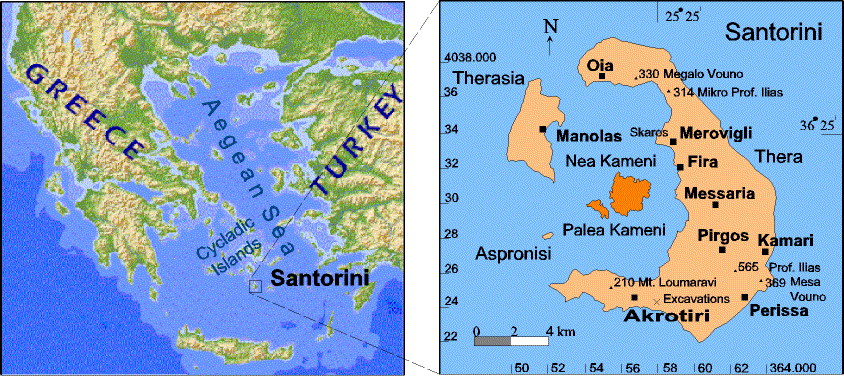 vulcanic
activity, which has changed its morphology quite often. The vulcanic
activity is still continuing in the central part (the little islands Nea
and Palea Kameni); the main island has the shape of a half moon and is
nowadays crowded in summertime with sun- and pleasure-loving tourists.
Especially impressive is the location of Santorini's main town, Phira,
on top of a cliff high above the sea, and it is a must for cruise sh
vulcanic
activity, which has changed its morphology quite often. The vulcanic
activity is still continuing in the central part (the little islands Nea
and Palea Kameni); the main island has the shape of a half moon and is
nowadays crowded in summertime with sun- and pleasure-loving tourists.
Especially impressive is the location of Santorini's main town, Phira,
on top of a cliff high above the sea, and it is a must for cruise sh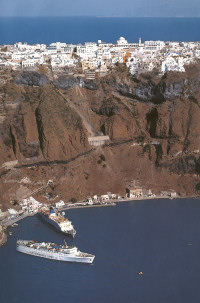 ips
to stop right in front of the cliff (see the picture). It doesn't
take too much fantasy to imagine that Santorini as it is now is a
remnant of what was once an almost round island with a central mountain
that was destroyed by the vulcanic explosion and was substituted with an
inner lagoon that is hundreds of meters deep.
ips
to stop right in front of the cliff (see the picture). It doesn't
take too much fantasy to imagine that Santorini as it is now is a
remnant of what was once an almost round island with a central mountain
that was destroyed by the vulcanic explosion and was substituted with an
inner lagoon that is hundreds of meters deep.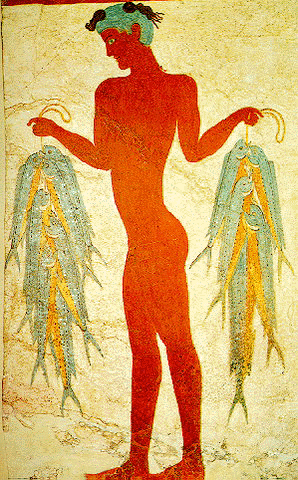
|
|
|
|
|
Hans de Ruiter, INAF - Istituto di Radioastronomia Via Gobetti, 101, 40129 Bologna, Italy
|
||